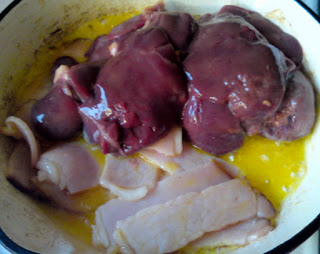
The organic butcher down the road always has a range of organ meats on display, so I decided to dive in and try my hand at using chicken liver in a paté, since it's a favourite of my Dad's. And although it's not a glamorous food when presented in a bowl via photo, it's delicious! Just don't think about its relationship to dog food...
Ingredients:
150g chicken livers 150g bacon 50g butter
Optional: Crushed garlic clove 1/2 onion, chopped Fresh herbs such as parsley and basil Spices such as pepper and nutmeg
Method:
Melt butter in a medium frying pan. Add bacon (and garlic and onion, if desired) and sauté until cooked through.
Add livers, and fry until they are cooked completely - break them apart to check that there is no pink left in the centre.
Transfer contents of the frying pan into a food processor, and add optional herbs and spices. Process until very smooth.
Transfer into glass bowl (ideally with a lid) and refrigerate. You may choose to melt extra butter and pour it over the meat (after smoothing the top) to create a delicious layer floating atop the paté.
Over the past two days, I've found myself being left unsatisfied by my protein shakes, and I started experiencing the hyperphagic effects of dairy, an experience that has been shared by others. So I'm closing off the protein shakes, although I am grateful that they helped me readjust to smaller amounts of food post-DepTran. I've also been experiencing some digestive distress, which may be due to the dairy overload or maybe due to adding potassium & magnesium supplements into my routine... I hear that the wrong dosage of these can have colourful results...
To maximise satiety & metabolic rate, and therefore fat loss, I'm heading back into my favourite way of eating - meat, meat & more meat! Fatty cuts of grass-fed/free-range meat deliver a solid amount of nutrition, calories, and satiety, so I eat as much as I can and stop when I'm just shy of full. I don't worry about calories since I know I'll be getting enough, and I seem able to burn fat even when in caloric surplus when it comes to meat... But to help me prove approximately how many calories I do burn in an average day, I have invested in a little gadget that's coming via ebay sometime next week... In the meantime, I'll be eating whatever meat I want, when I want. Down the track a little, I want to get back to experimenting with Alternate Day Fasting, but with meat as my food since it's what makes me feel healthiest.
My eats:
Tuesday
Protein shakes all day, and then two organic beef steakettes and cheesy scrambled eggs for dinner.
Wednesday
Protein shakes all day, then Chicken Liver Paté for dinner (see the recipe for pictures!)
Thursday
To help encourage my senior students to come to an early-morning class to make up for the class we'll miss due to net Monday's public holiday, I made them a selection of primal goodies, including 'Nola. However, the item that had them grasping for a second piece was a frittata of eggs, cream, spring onion, green capsicum, and feta cheese. Originally made as mini muffins but stuck in the pans, I tore out the contents and mixed the cooked eggs with more raw eggs, to create a pie-sized maxi frittata. Solution! And there was even some left for my breakfast and lunch.
For dinner I bid a last farewell to dairy and veg with a plate of delicious salmon sashimi, fried haloumi (which I recently learned is closely related to saganaki, if those unfamiliar with the former know of the latter), and cheesy sautéed cabbage.
Friday
After so many days of making shakes in the morning, I totally forgot to photograph today's breakfast & lunch - Tuscan (pork & veal & herbs & spices) sausages from Jonathan's.
When I arrived home, after a long day at this year's school swimming sports, I popped a free-range pork roast in the oven, and staved of hunger with a few slices of free-range bacon. A couple of hours later, I removed the pork roast from the oven, cut through its delicious crackling and revealed it's juicy, perfectly cooked centre... Ahhhhh - heaven!
Hurrah for a long weekend! The timing could not be better! Here's hoping the forecast humidity comes with some actual sunlight, since my exhaustion after the immenseness of this past week is starting to manifest itself as a head cold... Prescription: Rest, Vitamin D, Rest, Meat, and Rest!
I've been caught out a few times of late talking about the things I've learned about nutrition & health, and the current research I'm engaging with, and then being left without a place to point my audience toward. I tell them about my blog, but it takes a lot of digging to find the posts where I've discussed the then-latest findings.
So, in the vein of my Recipe Index, I want to build a collection of links to online resources here to help readers & stumblers find the information that has had a role in the development of my ideas about nutrition, as well as general lifestyle.
I'd love it if you, learned readers, could let me know of any awesome sites or articles that you've learned from, that you pass to your friends, etc, by commenting on this post with the link and explanation of its value. I'll pick out the strongest resources to use in this list - if we listed everything, we'd be here all day and the value of the reference guide would diminish. At the same time, if my categories list ignores an area you think important enough to include, let me know and I'll start building it! This will be a work in progress for a while, since I don't have heaps of free time to go gather all my info again. So the more collaborative this can be, the better!
An article posted on THINCS way back in 2002 is absolutely one of my favourite resources on the Internet when it comes to using science to totally dismantle the bogus Conventional Wisdom of cholesterol/LDL/saturated fat/CHD and everything that's claimed to link them. The article, Why The Cholesterol - Heart Disease Theory Is Wrong, involves thorough scientific discussion, buoyed by the author's frustration by the inexplicable arguments perpetuated by the medical community to this day. Everyone needs to read this article. The author, Malcolm Kendrick, MD, has written many more intriguing and insightful articles in the past decade - check the THINCS website for a substantial list.
"In Framingham, Massachusetts, the more saturated fat one ate, the more cholesterol one ate, the more calories one ate, the lower people's serum cholesterol...we found that the people who ate the most cholesterol, ate the most saturated fat, ate the most calories weighed the least and were the most physically active." Dr William Castelli 1992 (Director of the Framingham study) - cited in the Kendrick article above.
The word is getting out - this article may not be available online forever, at least not at this location, but for now The Boston Globe discusses the no-longer-avoidable truth about the importance and innocence of saturated fats in its article, Why Does Saturated Fat Cause? Arguments (published Feb 24th, 2010). For posterity, here's some juice from the opening of the article:
For the past 40 years, well-meaning specialists have told Americans that eating saturated fat is bad for heart health. It now appears that conventional wisdom is on shaky ground. Last month’s American Journal of Clinical Nutrition published a landmark study from the Harvard School of Public Health and the Children’s Hospital Oakland Research Institute that has turned current fat recommendations upside down. The verdict from the study is that “there is no significant evidence for concluding that dietary saturated fat is associated with an increased risk for heart disease.’’ Equally important, we are learning that restricting fat intake is not without serious health consequences, such as escalating rates of obesity and diabetes. The report evaluates dietary data from a total of 347,747 subjects from eight countries in 21 studies, over 25 years.
[...]
Dr. Ronald Krauss, the study’s principal investigator and director of atherosclerosis research at Children’s Hospital Oakland Research Institute, says, “It’s time to turn the page on how we perceive saturated fats in relation to risk for heart disease. It’s the wrong message that saturated fats are artery-clogging or evil.’’ Krauss says any dietary recommendations to further reduce saturated fat would be of no benefit. Americans, he says, shouldn’t be avoiding all forms of saturated fats and it’s erroneous to focus on saturated fat out of context from the whole diet.
[...]
In addition, high rates of obesity and Type 2 diabetes, especially in children, are one of the United States’ biggest public health concerns, an epidemic that happens to parallel decades of public health messages warning Americans that eating saturated fat is bad. As a result, many consumers instead eat commercially made low-fat confections that are full of sugar and high-fructose corn syrup. Eating too many of these calories can result in abnormal levels of blood sugar and triglycerides. These are well-established risk factors for obesity, diabetes, and heart disease. The question now is whether those efforts to lower dietary fat have caused a whole new set of chronic disease problems.
Kurt G. Harris, MD, offers a thorough explanation of the two types of diabetes, and how Type 1 MAY and Type 2 CAN be cured by sticking to the Paleo diet. Diagnosing either type in their early stages seems to be the point of importance if you want a chance at a cure.
As heart-warming as it is to know that more any more diabetics are ignoring the average doctor's advice (given that most GPs blindly follow the terrible advice of the ADA), it's still upsetting that for most diabetics, they have no option but to religiously follow the 'take more of the poison that's killing you' instruction until the day they die, full of bolus holes.
Thankfully, the online community is pushing the real information out there, through sites like Blood Sugar 101. And the Internet is rife with personal stories reinforcing how easy it is to treat/manage diabetes without medical interference. Sure, some Type 1's will need help through medical means. But not everyone. However, no one is helped by the ADA except the junk food companies.
There are three agreed-upon ways to lose weight: lower caloric intake, or burn more calories through exercise, or raise your metabolism. Leaving the specific food aside for the moment, lowering calories can have deleterious metabolic effects. As Ancel Key's Starvation Study showed, the subjects of his study intuitively consumed extreme amounts of food post-starvation in order to restore basal metabolism back to pre-starvation levels, and were left with increased amounts of body fat as a result. (The study itself is a hefty piece of work - the best summary I have found thus far is the metabolically-biased write-up by Matt Stone of 180 Degree Health. It may miss some details, I'm not sure, but metabolism is examined closely.) This is the body's natural reflex when finally allowed to consume as much food as desired. There's a reason why the term 'yo-yo dieting' is common parlance.
Matt Stone has recently presented the argument that our surprise that low-calorie diets can still result in fat gain is backward - that it may well be because of low-calorie dieting that we are getting fatter. His focus is metabolism, and in the face of growing obesity trends, it certainly seems logical.
Some of his other ideas, expressed most concisely in a guest post on Tom Naughton's Fat Head blog, are less logical: he argues that following a low-carb diet for a significant period of time will necessarily result in impaired (lowered) metabolic functioning. Kurt Harris, MD neatly tears this apart on PaNu. Melissa McEwan from Hunt.Gather.Love suggests that those low-carb dieters who do develop metabolic problems end up that way due to lack of consumption of marine life (i.e. a lack of iodine).
Iodine is crucial regarding thyroid function, and the observation that 'healthy eaters' who shun iodised salt are ending up deficient and developing the-now-almost-unheard-of goiters! Personally, the basic tests I had prior to being diagnosed with PCO (as opposed to PCOS) showed that it was unlikely that I had any thyroid function issues (although those tests aren't always accurate since they don't necessarily test for free T3). Just in case, I am taking a potassium plus iodine supplement, mostly for the potassium, to see whether it impacts on my well-being. If you do have a low body temperature or other metabolic issues, it's a good idea to be tested for hypothyroidism. Dian Hseih from NoodleFood has written a great article linking to more information regarding thyroid function, body temperature gauging, and hypothyroidism.
So instead of following the old chestnut of 'eat less, move more', which has been thoroughly disproved by decades of us following the guidelines and yet getting fatter and sicker, we need to attend to specific food choices, as well as maintaining our metabolism to operate at optimal levels. For me, my system runs best on fatty meats. For others, unrefined starches may be their metabolic cure.
Danny Roddy, of The Carnivore Health Weblog, hammers the last nails in the coffin of low-carb-causes-metabolic-damage with his excellent article, The Carnivorous Diet & Your Thyroid - which covers much more than just the carnivore's lifestyle. His conclusion:
You cannot correct one gland without having a profound effect on another. This is why I believe that nutrition is the best medicine. Optimizing EVERY system in the body is the only way to get everything back on track. Simply treating low thyroid with medication is silly when we can clearly see that the origin can be multifaceted; rooted in stress, allergies, or even environmental pollution.
If you come away with two things from this post let them be that grains are shit and avoid stress whenever possible. A carnivorous diet poses no threat to anyones thyroid. In fact if you are hypothyroid it's likely that you already eat too many carbohydrates, seeming that most cases are autoimmune or stress related in origin. Carbohydrate consumption in the form of easily digestible sugars and gluten containing grains have a negative impact on the thyroid and adrenal glands. My recommendation would be to minimize or eliminate them completely.
Josh Yelon has analysed a range of studies concerning metabolic rate change experienced though low-carb dieting - Effectiveness of Low-Carb Diet On Metabolic Rate. Look to his comments for a basic break-down of each studies' findings.
Traditional Diets & Modern Counterparts
Many advocates of paleo/primal-esque diets begin with the tenuous facts they can find regarding what paleolithic man ate, and build their nutrition choices around that. Loren Cordain of The Paleo Diet would be the most recognised of this group - his motto is essentially, "If it wasn't available, it's BAD."
Kurt Harris, MD, takes a different starting-point for his PaNu principles - he looks at the current science regarding what has been shown to be harmful, acknowledges that this includes most but not necessarily all Neolithic agents, and encourages the individual to work through a 12 step elimination process to find their ideal formula for health.
Mark Sisson's Primal Blueprint takes a similarly science-based approach, although he weaves the addictive Grok narrative into his dietary and lifestyle advice to (albeit artificially) contextualise his ideas. Whilst I don't romanticise my health choices, consideration of evolution certainly encourages one to take a more logical and scientific stance when approaching health and well-being information. MArk's work started my transition from low-carbing to going fully Primal (slash Paleo when I cut out dairy), and I can't thank him enough for his efforts and support over this past year. I look forward to watching him go on to take over the health & fitness industry!
The Weston A. Price Foundation is a pioneering group that is spreading the message of the importance of reverting to the 'old art' of preparing and consuming nourishing traditional foods, based on the wide variety of traditional diets explored by Price many decades ago (note: these people were nto eating pre-Neolithic diets, so the fact that they were indeed healthier than the average SAD consumer does not mean these diets were/are optimal). The certainly have good advice, but show signs of capitalist bias at times, promote dairy consumption heavily, and emphasise the supposed goodness of consuming grains once they have been sprouted and treated as they are by traditional communities. Many health experts question this method - should we be consuming poison that has been made less poisonous, or should we just eliminate it altogether? Kurt Harris, MD, answers the very question in response to a commenter's defense of a very questionable article. The last lines of his post are particularly powerful and significant.
Kurt Harris, MD, also knows a thing or two about the dangers of grain consumption; as a starting point, check out his Argument Against Cereal Grains.
In the video above, Robert H. Lustig, MD, UCSF Professor of Pediatrics in the Division of Endocrinology, explores the damage caused by sugary foods. He argues that fructose (too much) and fiber (not enough) appear to be cornerstones of the obesity epidemic through their effects on insulin. It's not as simple as Lustig makes it sound, but this is a good starting point for those ignorant to the potential damage of excess sugar consumption.
Nutrition & Cancer
Research of causal relationships between diet and cancer is an ever-exploding industry, lapped up by the media no matter how tenuous or inconclusive the particular study's conclusion may be - especially if the results can be twisted to suggest that the old Conventional Wisdom had it right all along. We usually don't end up receiving the true results, and many studies that can claim conclusive results are often dumped since the conclusion doesn't match up with what the scientists wanted to find... It's painful, and it's true of all aspects of 'nutrition science'. DC from DC's Improbable Science blog details this very issue in an article from last year, focussing on the widely-held belief that red meat & processed meats are giving us all cancer.
Dr. Michael R. Eades says: "Since cancers can't really get nourishment from anything but glucose, it stands to reason that cutting off this supply would, at the very least, slow down tumor growth, especially in aggressive, fast-growing cancers requiring a lot of glucose to fuel their rapid growth. If you understand the Warburg effect and the metabolism of cancer cells, it's easy to see why this therapy works, even in patients who at at death's door. Cancer cells get their energy, not like normal cells, from the mitochondrial oxidation of fat, but from glycolysis, the breakdown of glucose withing the cytoplasm."
On Dr. Stanley S. Bass' website, two analyses of studies exploring the link between diet and cancer cell growth are presented by Richard Friebe and Dr. Michael R. Eades. They explore the Warburg Effect - the spontaneous reversal of cancer progression when patients follow low-sugar diets. These accessible articles should be read by everyone who has cancer or knows a cancer sufferer, which in this day and age pretty much means everyone in the modern world.
Josh Yelon has analysed a range of studies concerning low-carb dieting's effect on cancer cell growth - Experiment Using Low-Carb To Treat Cancer. Look to his comments for a basic break-down of each studies' findings.
Although the causality is theoretical only, the history of cancer incidence in Inuit populations seem to align themselves strongly with the increase in refined carbohydrate consumption, so Ned Kock of Health Correlator details in his article, Cancer patterns in Inuit populations: 1950-1997.
Stephan Guyenet says - Got cancer? Corn Oil bad. Animal fats good (not helpful, but not harmful either). Well, at least in mice.
Living On The Fat Of The Land (The Carnivorous Lifestyle)
If you are considering trying an all-meat or wider carnivorous lifestyle, make sure you read the communication between Lex Rooker, a long-term zero-carber (one meal of ground, raw, red meat per day) and Kurt Harris, MD from PaNu - the conversation is quoted on Danny Roddy's blog, The Carnivore Health Weblog. In the same article, Danny discusses fat metabolism and points out the importance of eating to hunger and eating a REALLY high fat diet to ensure the body is willing to burn stored fats (i.e. isn't worried that it will need the stored fats any time soon - a touch illogical, huh?). This information comes from Peter's Hyperlipid blog, in a post entitled Weight Loss: When It's Hard.
Peter from Hyperlipid is an utter genius, and everyone should steadily read & do their best to make sense of every post on his blog. However, it has been hard to find places for his work in this guide since he doles out his genius in small doses! However, a couple of years ago he crafted a thorough analysis of whether fruit & vegetable consumption was in ANY way related to improved health. Answer = no. Not that this is a surprise to those of us currently keeping up with nutrition research and analysis - fructose consumption is being revealed as anything but the healthful substance it has been made out to be during these years of sugar (glucose) attacks.
A vocal proponent of the zero-carb lifestyle online is Charles Washington, who also brings together fellow meat eaters via his Zeroing In On Health forum. They're passionate people, and can be intimidating, but most are working from a thorough scientific understanding of bio-chemistry and nutrition. A great place to visit for advice and support, much like Mark Sisson's forum is for primal eaters.
Low Carb & Fat Loss
Dr. Michael R. Eades has sparked 'controversy' amongst many health circles by pointing out the metabolic advantage of limiting or avoiding dietary glucose consumption - the advantage being, the body needs to make glucose from dietary (one hopes) proteins, a process which uses energy itself. Not a heap, but potentially 100 - 300kcal per day may be 'wasted' through this and other process brought about by low-carb dieting. Eades has targeted his recent explanation of the metabolic advantage as a response to Anthony Colpo, who has, erm, 'colourfully' refuted Eades' claims, but shows definite signs of not really knowing what he is talking about - a trait shared by many non-scientists in the health and nutrition community. Eades recently quoted a thorough explanation of the metabolic advantage and thermodynamics as a whole by Dr. Feinmann in a recent post, and is a must-read for anyone who thinks a calorie is a calorie is a calorie, or that thermodynamics sounds like the dance equivalent of Bikram Yoga.
Paleo For Life has a Research section on the site where they have meticulously listed many studies related to the Paleo diet & lifestyle, and then followed each listed study with a collection of links to articles throughout the blogosphere analysing the results of the study and tying them directing to this way of living.
I'll leave this for now - I'm looking forward to your ideas! There are sites and articles that strike me as especially valuable, and I will be adding those, but that's only my opinion so I'd love to know what has really hit you as important and meaty, whilst still being clear enough for the average person with an interest in health to understand. Consolidated pieces that delve deeply and thoroughly into an aspect of health are best of all. :)
Time sure becomes tight when you're going through drug withdrawal whilst also preparing for a big birthday party! But it's good news all around - I'm feeling like my chipper self again (and am trying to ignore the NINE kilograms I'm carrying post-DepTran; here's hoping it is easy enough to shed), and my birthday party was very successful, both food- and fun-wise. I'm already looking forward to throwing a bash for the beau's next big day, although that's not until April... We seem to have enough leftovers to last us from now til then though - and not to mention the massive supply of alcohol now in the cupboard! I somehow ended up being given three bottles of wine as gifts - not bad for a non-drinker... So that means I'll have to throw some dinner parties to help share the wine with friends who don't mind a bit of tipple, although then they often bring a bottle of wine anyway, even if I tell them not too... Ah, what a hassle my life is. :P
So to briefly catch up on the eats of late - there have been lots of protein shakes during most days, so rather than bore you with every little detail, I'll just post some shots of the best actual food from each day of the past week:
Monday
Rockling coated in egg, almond flour and spices, a la my White Fish Fingers recipe.
Tuesday
Oopsie pizza, topped with smoked salmon, smoked bacon, and green capsicum.
Look how foldy!
Wednesday
A circular fry-up of zucchini, tuscan sausage from Jonathan's, fried eggs, and pepperoni.
Thursday
Jonathan's chipollatas & fried eggs
Salmon sashimi!
Friday
I intended to fast for the day, but since I was up half the night cooking desserts and crackers and such in preparation for Saturday's party, I had to nibble on a few things to check the flavours. I avoided sampling my desserts though, relying on the beau for the yay or nay.
First up I made Choc Date & Walnut Balls, forming both balls and slice pieces for variety. I then tried to make the recipe using the usual dried apricots, but the batch was drier than usual I suspect, as the mixture failed to hold together. I was left with a bowlful of finely chopped nuts and apricot, so I had to get a little bit fancy...
First I made apricot nut biscuits by adding coconut flour and almond flour, as well as eggs and coconut oil:
I then thinned the mixture with water and more oil to make a batch of muffins - some with added cocoa, some without:
I then used the rest of the mixture to make an incredibly dense yet surprisingly moist apricot & nut loaf - it disappeared within seconds or serving it on the day, which is why I'm left without a shot of it! The muffins were just as good, but their large size scared off party guests who were already full of the other menu items...
I then cooked up a HUGE batch of my delicious pumpkin soup - it was really hard not to spoon it straight into my mouth!
And finally, I made my birthday cake - a vanilla & cinnamon cheesecake on a nutty coconut crust, topped with whipped cream and berries. The guests couldn't believe it was sugar-free!
With everything in the fridge, I finally toppled into bed at around 2am...
Saturday
I ended up stuck in the kitchen, serving course after course, and didn't have enough hands nor time to get photos of everything, so you'll just have to imagine it...
Guests were greeted by platters of soft cheese, roasted nuts, primal crackers, and a number of primal dips: beetroot, spinach & basil (using cashew nut butter), and smoked salmon and olive.
Shortly thereafter, an array of single-serve Cauliflower Pizzas were served; some vegetarian, some with pepperoni and ham, and some with anchovies. Gone in a flash.
Then out came the fried chicken drumettes with caveman chicken sauce. The next day, my brother called to invite himself out to dinner on the condition that I would make him more chicken. And he's not a fan of fatty food. Win.
Once people had time to digest those (and the last few late-comers had arrived and were hanging out for some food), I heated up the pumpkin soup and served it with crumbled sunflower sesame crackers as croutons. Rave reviews! I'm really happy with this recipe - I don't have to measure anything any more, so I know I'll be able to make it forever.
That was the end of the savory courses, so then out came the muffins, balls & slices.
And finally, after we were into the swing of 80's SingStar madness, we whipped out the cake and topped off our happy bellies with delicious saturated fats! What a feast! And lots of happy faces! :)
Sunday
After sleeping most of my actual birthday away, I didn't want to eat anything but protein shakes until dinner time. This was a little awkward as my Mum wanted to take me out for a birthday lunch, but we all went along to a little place in Melbourne Central before going to the movies (I get a free ticket on my birthday).
When we finally arrived home, I whipped up tasty bits and pieces for the beau & Mum, focussing on one of the recipes I wanted to try for the party but didn't get around to trying - the fried goodness that others know as Popcorn Shrimp!
I treated my shrimp in the same way I do my fried chicken and fried white fish - coated in egg & then coconut flakes, almond flour, herbs & spices. Then into the coconut oil until browned and crunchy. Om nom nom!
Monday
Today, after weighing in to note a starting point for March (currently weighing more than I did this time last year, how crushing), I continued my protein shake ritual, breaking for dinner of two favourites - cooked & peeled prawns, and salmon sashimi!
And since the beau doesn't like raw salmon, I tried something to tantalise his taste buds... I kept the sunflower crackers that weren't quite the right shape, so I put them in a shallow bowl and crushed them back into sesame seed-sized crumbs. I then dipped the salmon fillet in egg and rolled it in the crumbs, then repeated the egg/crumb process. I then fried up the coated fillet in coconut oil, and served it on top of romaine lettuce to a boggle-eyed beau who squealed excitedly upon spying and then tasting the fishy treat!
So now that I've kicked the DepTran out of my system, and am reminding myself that it's NOT normal to want food late at night when there isn't a drug driving my hormones, I'm enjoying the return to tackling the challenge of creating small but satisfying meals that my particular physiology prefers!
Shahi Paneer recipe is my fourth recipe in the Paneer recipes series. In this recipe soft paneer cubes are cooked in a creamy, buttery gravy prepared with ghee (clarified butter), cashewnuts, onions, tomatoes and spices.
In the same vein as my much-loved Fried Chicken Fingers, I decided to give the almond flour treatment to some slender white fish fillets (I can't remember the type of fish, bad me!), bought from the organic butcher up the road, who also sells wild-caught salmon and other fish on Wednesdays. I'm not a fan of white fish, or any fish that tastes 'fishy', if you know what I mean. Solution? Herbs, spices, and coconut oil!
Ingredients:
4 white fish fillets (around 150g per serving) 1 cup almond flour 2 eggs 1 or 2T dried herbs - thyme, basil, parsley, etc 2t cumin 1t garlic powder Coconut oil, lard or butter
Method:
1. In a shallow bowl, combine almond flour, herbs & spices.
2. In a medium bowl, beat eggs until combined well.
3. One at a time, dip fish fillets into egg mixture, and roll in almond flour coating.
4. When all fillets are coated, heat oil/fat/butter in a large frying pan.
5. When oil is hot, gently place fillets in a single layer in the pan. Let sizzle until crust begins to brown and meat begins to become opaque.
6. Turn fillets carefully, and sizzle until crust is golden. Test to ensure meat is cooked thoroughly by slicing the end off one fillet.
Serve fillets immediately, with fresh vegetables and Lemon & Macadamia Mayo. If you like your root veggies, you could also make fries - et voila, the perfect Paleo replacement for Fish 'n' Chips!
Update (22 Feb) - also works on larger fillets! Check out the gorgeous rockling I prepared and scoffed down for tonight's dinner:
It requires care and precise spatula work to handle a 200g fillet of this shape and coating, but so long as you keep the amount of frying fat to a shallow depth, and flip way from yourself, you should do fine! The heat doesn't need to be terribly high either - no need to raise the fat to a spitting heat. Enjoy!
Without going on and on about the whole drug-induced hyperphagia bizzo, I'm still experiencing surprising bouts of deranged eating frenzies, as well as mood swings. However, my weight is holding steady, either because the six-week cure is doing its thing, or because the weight is mainly water-retention and my cells are full. My average food intake over the week is still much higher than I would like it, but I'm feeling a bit slimmer and have been receiving some leptin signals after particularly large meals (i.e. a protein shake with extra cream and water). The message might not last long, but it's an improvement. So that's the good news, but the bad news is that I'm still being taken over by the feed-demon every few days, and the best I can do is remove myself from all access to food. Last night I actually left the house at 10pm and went walking in my Vibrams, but ended up with such bad stomach pain that I had to call the beau to come rescue me after just an hour. Also, it seems like everyone but me has knowledge regarding the link between anti-depressants and weight gain. No wonder my doctor was always very keen to know whether I was having any 'reaction' to the drugs we were trying. I always thought he just meant fatigue...
Anyway, even if I've been eating what I'd class as too-much food some days, it's always been good food!
Thursday
Protein shakes for breakfast, recess & lunch:
Dinner - entree: salmon sashimi with a dollop of my Lemon & Macadamia Mayo
Dinner - main: kangaroo steak fillet, cheesy scrambled eggs, and chipollatas from Jonathan's, served with a bit of butter
Friday
Protein shakes for breakfast, recess & lunch.
Dinner:White Fish Fingers, bacon, sautéed red cabbage, and an avocado! I've been scared of avocados since a nasty sushi incident in 2004, but after watching this avocado slowly ripen in my fridge after being purchased for my Dips Recipes experiment, I decided to give it a go... Yum! If it weren't for all the fibre, I'd seriously consider putting avocados on regular rotation...
Lunch: snacked on brie cheese, blueberries, strawberries and a nuts & seeds mix at a friend's place. The beginning of a very bad appetite domination - makes me wonder about the role of carbs in this reaction...
But amidst the inhalation of Nola, lots of double cream, saganaki, and macadamia nuts, I managed to whip up another Oopsie Pizza for the beau and I. The eggs were freshly bought and therefore were at room temperature, resulting in a VERY fluffy crust. Yum!
Sunday
Like a good little catch-up faster, I ignored food for a solid 24 hours after breaking away from the pantry on Saturday night (and putting a couple of kilometres in between myself and the fridge), eventually breaking the fast with some leftovers from the lunch I made for the beau - a succulent preparation of roast chicken thighs using a lot of coconut oil and lots of chopped basil, plus other herbs & spices...
Before cooking:
After cooking (with a sprinkling of almond flour added mid-cooking):
I served the beau's share on top of sautéed red caabage and red capsicum, which itself was on top of romaine lettuce leaves.
I served my post-pushup dinner 'plain', although the flavour was anything but!
Yes, I said post-pushup. Why? Because, to help keep my beau to his plan, I have joined him in the Hundred Push-up Programme, which states that you can improve you push-up ability through adherence to their six-week programme. I finished Day Two today, managing to eek out 12 push-ups in the fifth set. I'm going to be sore tomorrow...
Due to today being a push-up day, I decided to wash dinner down with a protein shake, trying the Macha Green Tea flavour of Natural Factors' Whey Factors powder range. Interesting taste, and noticeably lacking in sweetness - a good thing in case a sweeter shake would have sent me running for the kitchen! So despite my fasting, I've met my protein intake minimum - no lean mass loss for me, I hope!
Back to work tomorrow, with shakes in tow, and a tasty meal already planned for tomorrow's dinner...
Until next time, I wanted to share with you a recent post of Melissa's Hunt.Gather.Love, where she presents a fantastic starting-point for discussions with non-paleo eaters, focusing primarily on health (right where the focus should be!). Her Human Health Quadrants diagram is a little hard to make sense of at first, but is an interesting way of looking at how particular lifestyles link to nutrition and environmental hazards. A very neat way to shut down the usual 'paleolithic people only lived til 30' bollocks, and a pithy picture to point out the realities of today's choices. I love it when the primal/paleo community works to make the info we amass more accessible to the average SAD-eater; a dynamic grass-roots movement is the best way to propel health understanding forward. Keep it up, team!