No, I don't have the rights to the name 'Cherry Ripe', so if I ever quit my calling and open a primal eatery, I will have to think up a new name - but for now I can live with it!
In my pursuit to perfect some decadent primal recipes, ready to whip up for family and friends at Christmas, I took advantage of the opportunity to have my brother over for dinner in order to get feedback from someone outside of the sugar- and gluten-free experience. However, the frequency of consumption made snapping photos difficult, so when I make these bites again (and I certainly will, given their response!), I will take the time to snap some nicer shots. If you make a batch of your own, I'd love to see the outcome!
Cherry Ripe Bites
This recipe was formulated to specifically replace the classic chocolate bar, which didn't so much have fruit in it as flavoured sugar. The primal equivalent, of course, fixes that problem.
Ingredients:
250g very dark chocolate - I use 100% cacao or coconut oil mixed with cacao powder, but I guess you could get away with 90% Lindtt if you need the sweetness. The fruit would do it for me. 75g coconut cream 100g dessicated coconut 50g cherries, chopped and pitted 1t ground vanilla or vanilla essence Optional - sweetener to taste
Method:
Melt chocolate (or combine melted coconut oil and cacao) and half-fill/coat the base and inner edge of your chocolate molds or silicon muffin tray/ice tray, etc. I had nothing suitable on hand, so I took a risk and used the egg holder from the fridge! Took some pounding, but they still came out fine :)
Combine all other ingredients roughly - if the mixture is a little dry (depending on the fineness of your dessicated coconut), add a tablespoon of heavy dairy cream and stir. Add more if necessary.
Roll cherry mix into balls/shapes just slightly smaller than your molds. (I used globs, but I would be more specific next time, so the chocolate isn't so thick around the filling.) Place into the holes and ensure you do not push the cherry mixture through to the bottom of the mold. If you're using clear plastic molds, double-check that there is still a strong layer of chocolate at the 'base' of the mold.
Top with melted chocolate until filling is covered. Refrigerate until set.
When set, press out of molds onto a plate, and keep cool until ready to serve. Enjoy!
I didn't have time to get a better shot - my brother was too keen to get it back in his mouth!
The guys didn't handle the dark chocolate very well, but scraped out the filling eagerly! I'll make the chocolate crust thinner next time - maybe dip the balls of filling into melted chocolate? Then I can bag them up and give them as Christmas presents!
In my pursuit to perfect some decadent primal recipes, ready to whip up for family and friends at Christmas, I took advantage of the opportunity to have my brother over for dinner in order to get feedback from someone outside of the sugar- and gluten-free experience. However, the frequency of consumption made snapping photos difficult, so when I make these tarts again (and I certainly will, given their response!), I will take the time to snap some nicer shots. If you make a batch of your own, I'd love to see the outcome!
Choc-Cherry Tart
Ingredients:
Crust
1 cup almond flour 1 egg 1 dash vanilla essence or 1/4t ground vanilla pods 1T butter 1/2t cinnamon Optional - enough sugar substitute to sweeten crust
Filling
(I'm listing the amounts I used, but I had extra filling so I cooked the excess in ramekins - worked very well too! Making one large tart may require the whole amount of filling...)
400g 100% cacao buttons (or cocoa mixed with coconut oil if preferred) 250g butter 3 whole eggs 5 egg yolks 200g cherries, pitted Optional - enough sugar substitute to sweeten as desired
Note - if you use a lighter form of chocolate, such as 90% Lindtt dark chocolate, you may need to decrease the amount of butter you use to balance the fat amounts.
Method:
Crust
Preheat oven to 150°C. Prepare a pie pan or muffin tray.
Combine all ingredients into a moist ball of dough.
Press dough into pan to make a thin but consistent crust density.
Place in oven until dough becomes a light golden-brown. (Note - if you notice the butter in the crust bubbling too much, turn down your oven slightly, as you want the moisture to stay bound in the almond flour)
Filling
Melt chocolate and butter, and combine well.
In a separate bowl, whisk eggs, yolk, and sweetener until fluffy.
Fold chocolate mixture into eggs gently.
Place cherries along the bottom of the tart shell
Gently pour the chocolate over the cherries until just covered. The mixture will rise a little during cooking. The filling mixture is as dark as the chocolate, but a thin layer of lighter, frothy mix may float to the top - quite a nice effect since the top of the tart then matches the colour of the base, and heightens the 'surprise' of the filling. But your mixture may not end up as frothy - it will depend on the quality of the eggs you use. I use organic, pastured eggs that do wonderful things - as Joel Salatin says, they express the true essence of egg :)
Place in oven until mixture has risen and bounces back when touched in the centre. It took around 30 minutes for me, but a large tart would take at least 45 minutes, at a guess.
Serve warm or at room temperature, with cream.
This batch made 6 muffin-sized tarts, plus three filled ramekins. It should be enough to fill a large pie dish.
Well, it certainly isn't light on calories, but the beau and my brother adored these little tartlettes! They gushed over the chocolaty insides and the joy of discovering whole cherries. I made six tarts with crusts, and three 'souffles' in ramekins, and the beau is steadily making his way through them - they're his current choice for breakfasts! As I am living as a carnivore at the moment, I could only watch and ask questions, but hopefully I'll be able to enjoy this delight on occasion in the future. Maybe it can be my Christmas treat!
After yesterday's epic post, here's a shorty to balance the verbosity.
Breakfast: Two pure beef sausages, and one egg fried in butter.
No time for lunch, so stayed fasted until dinner ten hours after breakfast.
Dinner: Scotch fillet steak, served with a pat of butter.
And we're done! Weight continues to drop, skin is great at the moment, hair stays clean and free of oil for incredible stretches of time, and I'm completely over my cold!
Once last thing before I leave you - I stumbled upon an article posted way back in 2002 by Charles Eisenstein entitled The Ethics Of Eating Meat: A Radical View, espousing most of the same information as is currently taking the health and diet world by storm via Lierre Keith's The Vegetarian Myth. It doesn't have her flair for language, but it also isn't as dampened with anecdotes, so it might be a better one to pass on to the science-loving friends and family who still believe the usual myths about industrial agriculture/husbandry vs the potential of alternative methods, and their relationship to fossil fuel and other environmental woes. Enjoy, and good night!
Michael Pollan said it in an interview with Bill Moyers this time last year. Lierre Keith again has stated it in her book The Vegetarian Myth. Rebecca Hosking also talks about the ’10 calories of fossil fuel for 1 calorie of food produced by contemporary agriculture’ in her elegant and accessible documentary, A Farm for the Future, which I have embedded below. And these are just the references I’ve come across today, but it’s a message that has long been put forward again and again by scientists the world over.
So why do ‘experts’ (read: politicians sponsored by Big Agra and vegetarians) keep propagating the myth that red meat is what is destroying the planet? Don’t they see that a big part of the ‘red meat problem’ is that agriculture is used to provide the feed for factory farmed animals? Why do they continually blame the fact that cows fart out methane, without considering the impact of a non-natural diet on their digestive processes?
Instead of weighing in on the yapping match, I wanted to share with you the findings of my latest explorations inspired by Lierre Keith - she elegantly puts forward the issues of soil maintenance and the necessity of animal products in the human diet, but there still hasn’t been a conclusive solution to the fact that modern farmers, even those raising their animals primarily on pasture, still rely on fossil fuel to power their machines for transportation, harvesting, and other vital farming activities. So I have been spending time reading about farming methods which are doing away with the reliance on oil without requiring massive amounts of manual labour nor struggling to produce enough food to feed the farmers themselves, let alone the rest of the world...
First, I encourage you to view Rebecca Hosking’s documentary below, outlining the problems faced by British farmers (and relevant to the rest of us), through to some possible solutions. I have written a basic overview of some parts of the documentary to lead into my own thoughts, so if you don't have time to watch the 50 minute film, you can get the basic message from my notes.
Part One - Rebecca looks at the necessity of change in current British farming practices, and is faced with the facts regarding the inevitable energy crisis once oil supplies hit their peak (predicted to occur at 2013 at the latest, causing not just an energy crisis by an economic meltdown unless we find ways to cope now)
Part Two - how to move forward. Alternative energies? Richard Heinberg tells us that the window for developing alternative energy sources has passed if we wanted them to allow us to pick up where oil left off. He bluntly states, "We're going to have to transform our entire agricultural system very quickly if we are going to avert a global food calamity." But how to do so? Revert to old systems of manual labour and horse & cart machining? Considering that today’s farms use oil-guzzling tractors with 400 horsepower, we can see that even if we went back to traditional ‘machining’, we would have to increase the amount of farms and farmers significantly, to feed the population.
Part Three - Raising cattle is not superficially labour-intensive, but depending on climate, farmers must protect animals from the cold of winter and supply them with hay, protect delicate pastures from hooves during the wet season, or ensure animals are well hydrated and have access to leafy summer crops in hot, dry summers (the situation in most of Australia - certainly the experience at my family's farm). Rebecca meets a family who have used the power of nature to create grass pastures that can avoid the usual British problem of delicate fields, but it's not an easy process to replicate. Each farmer would need to examine their local soils and experiment with a variety of grass species to find what can work for them. This piece is the first of the documentary to touch on the important message - that we need to understand nature and work with the eco-system in order to have it work for us.
The radical idea presented by the documentary (though no surprise for those of us familiar with the devastation caused by modern agriculture) is the argument against plowing. Plowing kills the soil - it is akin to humans ripping off their own skin. The documentary demonstrates the traditional reaction to plowing - birds coming and feasting on the fauna in the soil. After years of plowing the same field, birds no longer bother showing up, since there’s nothing alive in the soil to it - the nutrients have been ripped out, leaving nothing for subterranean animals to eat. The only way we currently cope with this destruction is by pumping the soil full of fossil fuel fertiliser - so what do we do when that’s gone?
Without oil, countries cannot import/export foods, so will require a return to local produce. Countries of small size with dense populations, like Britain, probably cannot feed their entire population on meat alone, simply given the amount of space cattle etc need for grazing (since that is the only sustainable way for them to be fed). But what are the other options, given we cannot endlessly rip up the soil if we cannot rely on oil for fertility?
The likely solution to this question, drawing on the principle outlined earlier or allowing nature to behave as it wishes to, rather than have farmers fight the landscape, is Permaculture. As Wikipedia puts it, "Permaculture is an approach to designing human settlements and perennial agricultural systems that mimics the relationships found in natural ecologies." The key term is design - intelligent, informed construction of human necessities within the 'ordered chaos' of nature.
Part Four - the amazing, low-energy potential of establishing forest gardens within natural woodlands. A small farm produces all the fruit, vegetables, and meat the owners need, plus the fuel to cook it. This is a farm that has not been designed to produce maximum yield, yet it comfortably feeds them with minimal effort on their part. Every element of the eco-system plays a role in maintaining the environment and soil fertility - the 'closed loop' effect of permaculture. An answer to the winter hay/summer crop issue is suggested by Rebecca's realisation that certain types of trees can serve as fodder crops for animals - naturally occurring food that the animals would probably have eaten more often than grass when living wild. I imagine this would make the meat even more delicious as well, as anyone who has tasted lamb fed on saltbush, or roo that graze on all sorts of native trees and shrubs can attest!
Part Five - Martin Crawford (Agroforestry Research Trust) details the benefits of forest gardening and the way nature works to sustain itself and how intelligent design helps to 'deal with' conventional farming/gardening problems. Fossil fuel need not apply. How much work is done by the humans? About a day per week, when harvesting is taken into consideration. And considering a farm designed for maximum yield could feed ten people per acre, this is very promising...
One "downside" that Rebecca details is the inability to grow cereal crops in forest gardens. Oh noes! You could not wipe the smug grin off my face when I found that out, especially when Martin then went on to explain how nuts would be a far more sustainable alternative, especially given that the density of growth can be equal to that of organic cereal grains without the need for a soil-raping monoculture, and the nutritive value of some nuts is 'similar to rice' (or, as we know, MUCH better for us than any cereal grain!). Plus, a nut orchard requires very little maintenance, again saving on manual energy - important if we are to maintain civilisation without requiring a great percentage of the population to return to farming. An informed gardener with an eye for detail can grow five times as much produce in a vegetable garden than modern farms currently can.
Perhaps we will return to Victory Gardens? Supermarkets and industrial farming is likely to decline as oil declines, so we need to act now to reawaken the farming traditions and improve pastures, moving into Permaculture - perhaps creating more kitchen gardens in our schools, urban community gardens and larger local providers close to metropolitan centres.
This film has joined the ranks of important and accessible texts that I will be doing my best to work into the school curriculum in the future. As Rob from Transition Culture says in his review, "We are all in Rebecca’s debt for so passionately and coherently showing the nation both that food and farming is in desperate need of a Plan B, and that that Plan B could actually be more biodiverse, more resilient, more beautiful and nourishing, than what we have come to view as ‘normal’."
Personally, I am thrilled that I now understand the value and importance of Permaculture, an Australian concept, since my sister-in-law and her husband are passionate and educated proponents of the system, having spent time living and working on a farm in NSW - the Permaforest Trust (that's them in the 'surveying' photo!), whilst completing their certification and building a mud hut! I look forward to picking their brains when I see them in January. My mother also nurtures a kitchen garden and a few chooks at her primary school, where students can go in and get their hands dirty, learning directly how to care for crops, using methods such as companion planting to keep pests at bay. For now, I grow my own herbs, buy my organic vegetables through a neat local system (local farm > market > organic store > me) removing the need for individuals or stores to travel out to the farms themselves. Most produce is grown in Victoria or just over the NSW border. I buy my meat through an even neater system - Organic Direct serves as the go-between from a farm not too far from Melbourne, to individuals in the city and surrounds. Fossil fuel is saved by the company making just one trip from farm to customers per month, covering everyone in one weekend. We then supplement this monthly (or bi-monthly, usually) haul with trips to the local organic butcher, which is less sustainable, but at least the meat is still local and not factory farmed. Plus, I either walk there, or it's a quick drive in the Prius.
So here are the meals I fueled myself with today - and while I'm not completely free of fossil fuel reflux, a couple of mild burps are much better than what the industries would like me to regurgitate:
Breakfast: since I woke up late and had big plans for lunch, I wanted to keep breakfast quite small. But then this lamb chop called to me from the fridge...
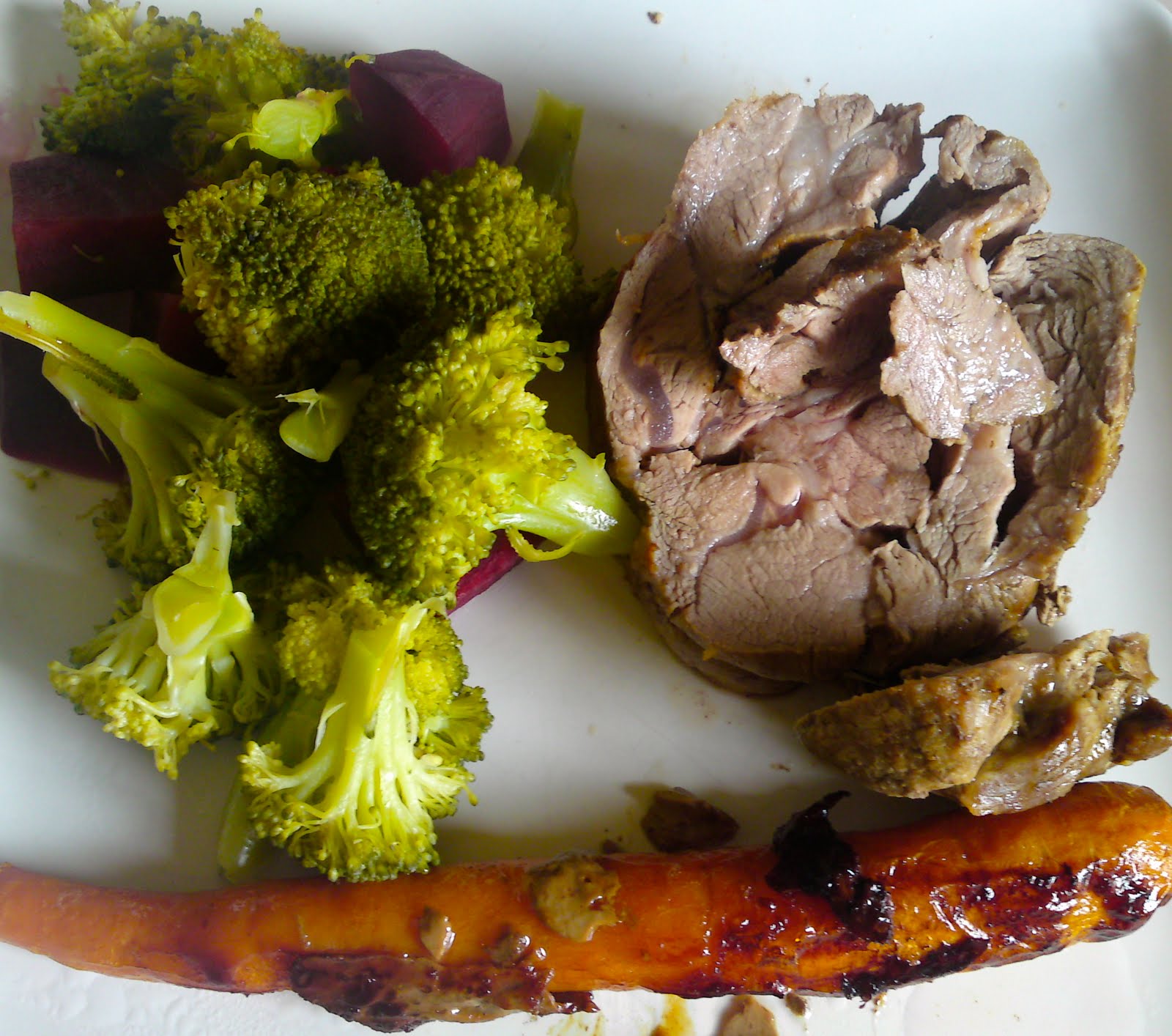
Lunch: We're consuming a roast per day at the moment, and don't I just love it! I served the beau a pile of organic veggies with his - beetroot, broccoli and carrot - not just to make his plate more visually interesting, and use the contents of our weekly veggie box for once, but also so I could hog most of the meat for myself!
However, thanks to my chunky breakfast, I didn't quite manage to scoff my entire serving. I ate too much as it was, and had to take a nap whilst my digestive system sprung into action! Preparation for Christmas feasting, mayhaps...
Dinner: after the lunch experience, I wasn't going to eat anything else, but my calories for the day were a bit low, and I didn't want to risk allowing my cold to gather strength and return, so I took in a small meal of bacon and eggs as the sun began to set...
My weight continues to drop, with my system today letting me know that fat is indeed being burnt, thanks to the unmissable reaction to toxins re-entering my system as they are freed from fat cells. Let's just say it was good to have a day at home, nice and close to a bathroom...
So that's my current food-oriented effort to find a way of surviving on less fossil fuel. I also walk to work, and minimise my need to travel by car where possible. My partner works in the city, but carpools in his Prius to cut down on fuel requirements. We're both heavily reliant upon electricity since our jobs require computers, but we use green energy and buy carbon credits when we can, especially when we use air travel. We still have a long way to go, but we're doing okay.
Further reading:
If you have the space and desire to start your own organic permaculture garden, here's a neat 10-step run-down of how to get it started.
If you're in Melbourne and wish to find local groups that can help you start your own garden or give you information on how to support the efforts of others, check out Permaculture Melbourne. I bet other major cities around the world have similar organisations, or at least individuals who are willing to help you out.
The Salatin family in the US established a larger scale farm that is thus far the closest thing in America to a sustainable farming system - Polyface Farms. Joel Salatin is a vocal proponent of this way of farming, and pops up all over the place, so if you come across an interview with him (and there are many online resources to get you started), read and absorb the fresh wisdom of this guileless, earnest farmer.
And, as always, have a browse of the Weston A. Price Foundation's site, if you haven't already, for eye-opening science covering traditional foods, contemporary foods, and the impact of each on health.
Think before you eat. Consider the energy expended in raising, processing and transporting your food to you. And do everything you can to reduce your impact on fossil fuel use. That way, there's no reason to feel guilty about eating your one cow per year, especially if you know its existence gave back to nature through soil fertilisation. Supporting or creating your own Permaculture farm is just another way of knowing for sure where your food comes from and what was used to produce it - and that knowledge is increasingly powerful. And as always, the most important rule to live by is: Eat real food. And know where it came from.
I feel wonderful today! I still have a bit of a sniffle, but the swollen throat soreness has finally dissipated, and my energy level is almost back to normal. Plus, I am looking and feeling quite svelte thanks to cutting the carbs again, I've dropped a pound, and my subcutaneous fat is shrinking (leaving jiggliness and temporary excess skin that I can't stop grabbing and stretching to prove to myself that fat has disappeared!)
The boon of healthfulness has almost out-weighed the negative whinge-fest I'm currently battling, thanks to it being Report Writing Time. I'm plowing through, and I still have a few days, so it's not critical just yet. But I'm already looking forward to how relieved I'll be when this sword of Damacles is no longer aloft my consciousness. In the meantime, I've been using my favourite form of procrastination to its full potential - cooking!
While one recipe still isn't quite ready for publication (mainly because I haven't managed to get a good photo, and the beau is trying to make them last so I don't get many opportunities), I did make another batch of lovely Choc Apricot & Walnut Balls, rolled in coconut:
Still haven't tried one in its entirety, but the beau is steadily making his way through this newest batch, so let his behaviour tell all...
My day involved three separate species of animal, so that's pretty good by my standards.
Breakfast - pure beef sausages from the organic butcher; so tasty for plain meat!
Lunch - whipped up a batch of chorizo, bacon and egg stir-fry for the beau and I, and finally snapped some lovely pictures! Thank you, sunshiny day!
Dinner - organic corned beef silverside. Much leaner than I'm used to, and lower in sodium... I had to add thyme and salt to make the stuff edible. Shame...
But I did have fun trying an idea that I read about eons ago - sticking the cloves into the onion rather than just letting them float around! The beau even ate the ultra-tasty onions afterward, as well as some boiled carrots.
Me, well, I stuck with the obvious...
I have defrosted another lamb roast. It's already haunting my dreams. I think it needs to be eaten for lunch tomorrow. Om nom nom....
Food for thought:
A few articles about ketosis have been popping up of late, mostly positive, but today Peter from Hyperlipid posted an opinion piece on ketosis and its value. A definite must-read for anyone who follows anything close to a ketogenic diet - just like a new drug might save your life, you also would be wise to look up the potential side-effects so that you know what to look out for. Peter has collected all the significant and relevant information regarding the opposition of ketosis, and his post has inspired some very thoughtful comments from other experts. Like Peter, I am still in favour of ketosis as a fat-loss method since I seem to function very well that way, whilst visibly burning fat. I'll be interested to know what it is like when I have less excess fat to burn...
Also, I've taken advantage of Dr. Mercola's current free shipping offer and bought up his ceramic cookware, bakeware and teaware products, as well as his natural sunscreens and bug repellent. I wanted to buy his cookware ages ago, but shipping bulky pans to Australia from the US was going to cost more than the products themselves! So when his email newsletter told me about the Black Friday sale (til Dec 2nd) I dove straight in! I'm very excited, since my el cheapo Raco ceramic-coated cast iron pan set has started to crack! Unbelievable! My Le Chasseur cast iron products are in perfect shape though, but they're soooo heavy that it's a pain to use them. Fingers crossed that the Mercola stuff is as light as they say... And no, I'm not being paid to promote these products, I'm mentioning my purchase purely to let like-minded individuals know about what I consider to be a sweet-ass deal! I can't wait to try his sunscreen - I don't want to have to hide from the sun in fear of burning when I'm up north for a week! And DEET-free bug-spray that WORKS is a thrilling concept!! I'm sick of my nail polish melting off when I spray my feet!)
Just over one month of 2009 left folks... It's been a year of huge changes for me so I'll almost be sad when 2010 rolls in - but it will be nice to be able to label a year's worth of fat loss and health improvement! My outlook on life has changed so much too, for the better, and hopefully this transition to a far more mature, objective, environmentally-aware mindset will be permanent and inspiring to others. So many people have inspired me this year, most of them participants in the online health & primal communities, so I hope that this blog is giving back something in however small a way. Even if my life speeds up and I no longer have time to maintain this blog, it's great to know that it will stand as a resource for future health-seekers to find and learn from, to help them on their own journeys.
Carnivorism is paying off already! I'm feeling better (despite some lingering head cold symptoms) and my remaining body fat is getting jiggly, which is a sign of fat burning. Another sign - the unmistakable taste of ketosis kicked in not long after breakfast, and hasn't left the village for long at any point over the course of the day. The bonus of the slightly icky taste - apart from the knowledge that fat is being burnt - is that it encourages me to drink more water, helping to flush this virus out of my system.
Despite today's weather hovering in the humid tropics for most of the afternoon (it's nearly midnight and I'm still glistening as I sit and type this, despite the fact that I'm only wearing one of my new, slinky jersey dresses), I didn't mind cooking up a storm for three of my four meals. Yep, four meals. I photographed three of them:
Breakfast - after wasting so much food yesterday morning, I went for a solitary lamb chop today. It seemed like it was enough...
...but by 11am, three hours post-breakfast, I was in major keto-mode and feeling a bit under-fueled. So I reached for my stand-by can of tuna in springwater, which hit the spot! Amazing what 73 kcal can do when it's protein - consider the lack of staying power if it were the same amount of food in candy form!
Arriving home at around 5pm, hunger had set in again, so I whipped up a new favourite - chorizo sausage and egg scramble. I managed to snap a vaguely pleasant photo this time around.
And the pièce de résistance, roast lamb! Organic, Demeter, rolled and lightly seasoned, with an enjoyable amount of fat and an unbeatable flavour! My 300g serving went down a treat - I just wish there had been more... To the butcher!
And to round out this fairly average week, I was sifting through my blog subscriptions, cleaning out those which haven't presented a new post in over a month, when I stumbled upon a post from the now-quiet Thrifty Dieter's Blog, authored by a Twitter friend of mine. In this post, she quoted one of my posts during my first all-meat experiment. It drew me back to my post, way back in July, and it was wonderful to reacquaint myself with my mindset back then - a simpler, streamlined version of how I now think. It has encouraged me to let go of a few complications when it comes to food, and get back to enjoying meat for what it is - the healthy, delicious food out of which humans can get every drop of nutrition.
My multivitamin stash has just run out, and I catch myself stressing that I will be missing out on something. Now I will stop those thoughts and remind myself - 'I eat meat. Natural, grass-fed, sustainable, chemical-free meat. It has everything I need.'
I stress about how to respond to 'dietary requirement' requests when invited to weddings and parties. Now I will quit worrying about appearing like a freak and just write down 'I eat meat' - and when I show up, all I'll appear to be is gorgeous and happy.
I eat meat. I eat meat that is naturally, ethically raised and sustainably farmed, helping to combat the current environmental issues. As Don Matesz discusses in his the second part of his review of The Vegetarian Myth:
Ms. Keith addresses all of the other claims made by political vegetarians against animal husbandry, like that it uses more fuel than monoculture or causes global warming. In fact raising animals on grass is more fuel efficient than raising row crops, and monoculture of row crops has a net effect of releasing carbon into the atmosphere whereas raising ruminants on pasture has the net effect of sequestering carbon.
I often wonder what would have happened if, at the beginning of this journey, I had been persuaded by a vegetarian publication that theirs was the way to go for weight-loss (my primary goal at the beginning of the year). Would I have been totally blinded by vegetarian propaganda or would I still have chased down more general health blogs and been faced with the realities of necessary animal product consumption and the results of a diet high in grains, sugars, and starches? I suspect I would not have found the scientific facts surrounding general health, since my initial motivation was quick fat loss in the first month, and I bet I would not have had that experience going vegetarian. I probably would have gained weight, if I am insulin resistant (all signs point to yes, especially with the PCO in the mix).
So I am still so thankful that I was in that Bento place that day last November, flipping through that Women's Weekly, when I stumbled upon that article telling me to cut carbs in order to lose weight. And then I spent those two months leading up to Jan 1st researching what low-carb actually was, and whether it was safe, and was convinced that it was (despite there being more science-void "DANGERS OF LOW-CARB" sites out there than scientifically-valid endorsements of the lifestyle. Good thing I can tell the difference and don't take things on face value. I owe so much to my unending sense of curiosity!). And then, oh, the wonderfulness that was January, and every month, week, day, MEAL since then!
I eat meat, and I love it, and it loves me!
... but I still make a pretty kick-ass cheesecake.
Forced to take just one more day off work (missing the best conference of the year, boo!) while the last of this bug is worked out of my system, I didn't get to slack off - reports are due tomorrow, so I've been busily marking exams and writing as euphemistically as possible about my dear cherubs. Fear not - I still found time to get into the kitchen, and even had some fun experimenting with new ideas in the evening!
Breakfast proved too much for me - I only managed to down the bacon and a bit of lamb chop before hitting satiety... And this is after fasting since lunchtime yesterday... Odd.
For lunch I sliced up some fancy new chorizo sausages found at the local supermarket - no filler, no sweetener, just beef, pork, and spices, smoked! Zing! Fried them up, and scrambled in some eggs - yum! Sadly, there's no photo since a freak storm hit just as I finished making my lunch, and the power went out. My camera's flash was too powerful for the contrast of white plate/eggs with dark meat. Next time (oh yes, there will be a next time!)...
On to dinner, where my appetite was starting to come back, so my grilled salmon filled and chorizo sausage slice was highly appreciated!
And now for a couple of teasers - here are glimpses of the two recipes I'm currently working on... You'll have to wait until I have perfected the recipes and have more spare time...
My taster tells me that one of the recipes is already perfection, so keep your eyes out for that recipe popping up here in the next day or so!